
Text Analytics and the Hidden Stories Within: Understanding Topic Modelling with LDA
Imagine walking into an enormous ancient library where millions of scrolls lie piled in chaotic clusters. At first glance, the collection feels impossible…
Imagine walking into an enormous ancient library where millions of scrolls lie piled in chaotic clusters. At first glance, the collection feels impossible to understand. Yet, a skilled storyteller could wander through the shelves, sensing patterns, isolating recurring ideas, and grouping scrolls according to themes that are never explicitly written on their covers.
Topic modelling works in much the same way. Instead of a grand library, it explores vast document collections, detecting invisible threads that connect words, paragraphs, and entire texts. Many professionals build the foundation for this craft through structured programs, such as a business analyst coaching in hyderabad, which introduces analytical thinking essential for interpreting hidden textual patterns. But the true magic lies in how Latent Dirichlet Allocation transforms raw text into meaningful narratives.
The Whispering Library: Why Themes Hide in Plain Sight
Human writing is complex, expressive, and layered. A document rarely announces its themes openly. Instead, meanings whisper through word frequencies, co-occurrences, and linguistic rhythms. Consider a set of travel diaries. Some may talk about mountains, others about food, and a few about architecture, yet none explicitly state their central themes.
Topic modelling treats collections like this as a landscape of clues. It observes how words travel together — how “spice,” “market,” and “street food” keep appearing in similar contexts. These repeated patterns, scattered across numerous documents, become signals of an underlying theme waiting to be uncovered.
LDA: The Cartographer Mapping Invisible Landscapes
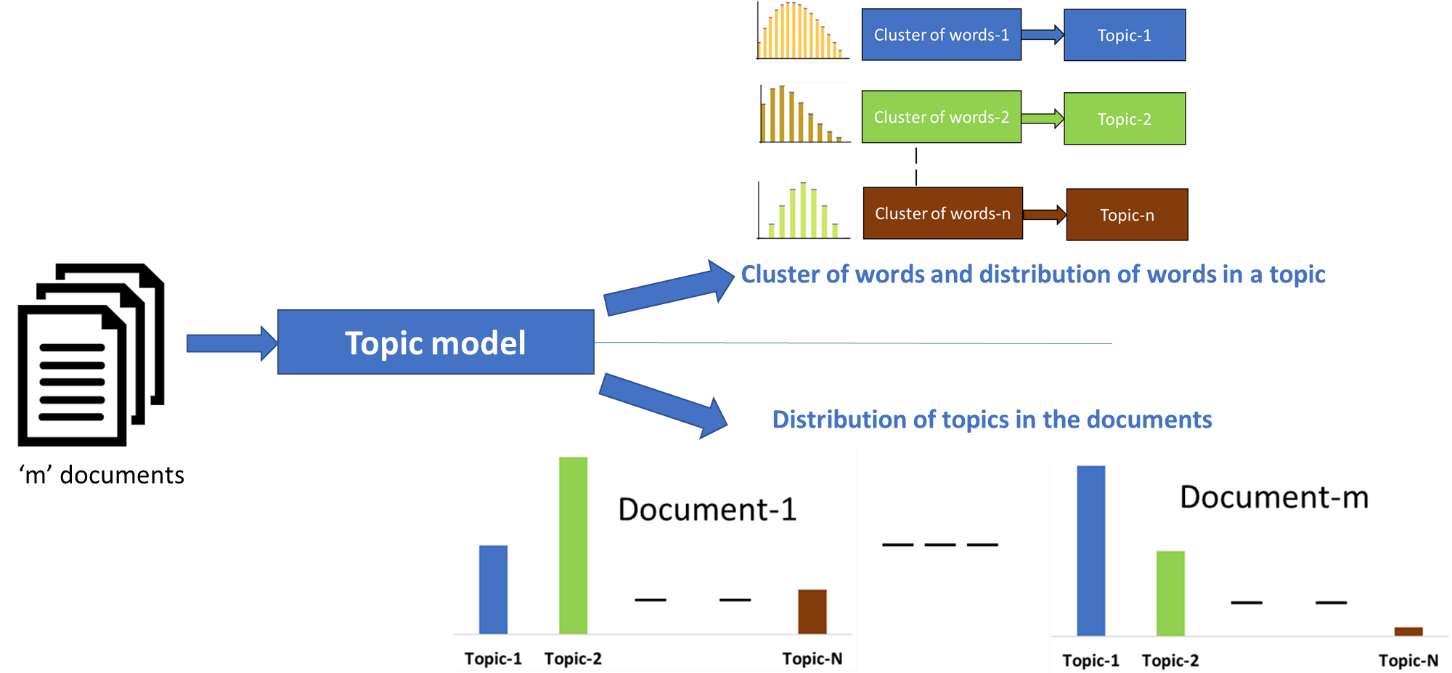
Latent Dirichlet Allocation (LDA) behaves like a cartographer charting territories that lie beneath the surface. It assumes that each document is a blend of several topics, and each topic is a blend of words.
Picture a painter mixing several colours to form a canvas. The final artwork doesn’t show pure red or pure blue, but subtle shades where these pigments mix. LDA reverse-engineers this painting. It identifies that a document may contain 40 percent “travel food theme,” 30 percent “local culture theme,” and 30 percent “transportation theme.”
Through probabilistic calculations, LDA extracts patterns that would otherwise remain buried, giving analysts a structured way to interpret large-scale text.
The Dance of Words: How Probabilities Reveal Meaning
LDA’s strength lies in understanding that words rarely stand alone. They behave like dancers on a stage whose movements reflect relationships. When “visa,” “airport,” and “documentation” frequently appear together across different articles, LDA recognises this choreography and assigns them to the same thematic cluster.
Similarly, when emotionally charged words like “conflict,” “tension,” and “negotiation” repeatedly co-occur, they form another cluster.
The model studies thousands of such micro-patterns and arranges them into meaningful macro-themes.
This process becomes especially useful in domains like customer feedback, social media insights, policy reviews, or academic literature — areas where the volume of text overwhelms traditional reading approaches.
Bringing Order to Chaos: Applications that Shape Decisions
Once themes emerge, organisations can convert them into actionable insights. A company analysing customer complaints may uncover recurring frustrations about pricing or delivery delays. A policymaker reviewing public grievances might detect hidden clusters around infrastructure, healthcare, or education.
These insights don’t just describe what people say; they reveal what people mean.
Such nuanced interpretation is often cultivated through systematic learning, for example, in a business analyst coaching in hyderabad, where professionals learn to connect abstract textual patterns with real-world decision-making.
LDA becomes the bridge between raw data and strategic clarity, enabling leaders to navigate complexities with confidence.
Reading Between the Lines: The Analyst’s Role
Though LDA uncovers themes, analysts must interpret these patterns. They refine topic counts, label clusters, and validate whether the themes discovered truly reflect the underlying data. This role is less like a technician and more like a storyteller — one who deciphers faint signals and transforms them into meaningful narratives.
Tools such as Gensim, Python, R, and machine learning frameworks enhance this process, helping analysts explore data visually through topic graphs, coherence scores, and word distributions. The art lies not just in the algorithm but in the human ability to contextualise what the algorithm uncovers.
Conclusion
Topic modelling through LDA is a powerful way to reveal the hidden stories within text. It treats words as signals, documents as mixtures of meaning, and large corpora as undiscovered landscapes.
By combining the intuition of a storyteller with the precision of probabilistic modelling, organisations can extract themes that inform strategies, guide decisions, and deepen understanding. In a world overflowing with unstructured data, LDA stands as a compass — pointing leaders, analysts, and innovators towards the narratives that matter most.